The construction site: a new strategic frontier for situational robotics
Construction robotics is entering a new phase thanks to the integration of artificial intelligence, enabling machines to adapt in real time. Unlike traditional industrial robots, which are limited to controlled environments, these systems analyze their surroundings, interpret situations, and continuously adjust their behavior. They no longer simply execute pre-programmed tasks—they make decisions in unstable and unpredictable contexts. This evolution, often referred to as situational robotics, marks a turning point for the construction sector, making it possible to achieve greater automation that can cope with real-world conditions.
Why construction sites represent a major technological challenge
One of the main obstacles to adopting robotics in construction lies in the very nature of construction sites. Unlike factories, where environments are controlled and optimized, construction sites are inherently unstable and constantly evolving. Terrain changes, weather conditions vary, teams interact, and unexpected events are constant.
For a long time, this complexity limited the use of robots, even though the sector is already structured, as highlighted in the Sifted x Leonard report on robotics published at the end of 2024.
As Phil Reid, Head of Innovation & Transformation at VINCI Construction UK, reminds us regarding the very purpose of robotics in construction: Whether we are constructing or maintaining the built environment we have the same challenges of safety, productivity, health, quality and waste. We are reaching the end of the improvements that we can make with people carrying out manual tasks or directly controlling machines, to meet the needs of society we must harness the power of computing and engineering, deploying robotics and a variety of Computer Controlled Machinery.
Today, advances in artificial intelligence, computer vision, embedded sensors, and precise geolocation are helping overcome some of the sector’s constraints. Robots no longer just execute programmed tasks; they perceive their environment and make appropriate decisions, paving the way for truly operational on-site automation.
Autonomous machinery: already a reality in structural work
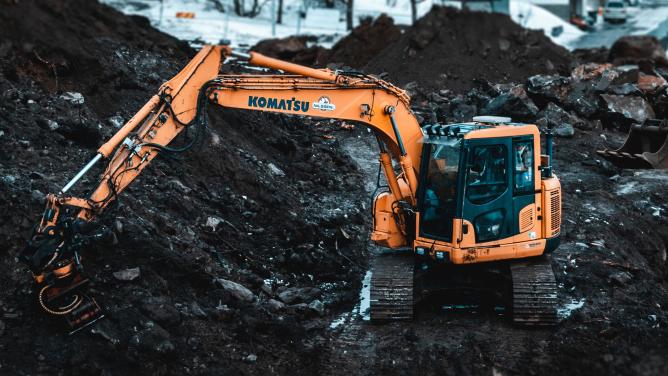
Robotics is already visible in structural construction, where autonomous construction equipment represents one of the most advanced segments. Companies such as Gravis Robotics (Leonard Catalyst 2026 program), Built Robotics, and Bedrock Robotics are transforming traditional machines into systems capable of operating autonomously.
These machines no longer simply follow predefined plans. They analyze the terrain, adjust their movements, and detect anomalies in real time. This ability to evolve in imperfect environments brings these solutions closer to the development of autonomous vehicles, explaining their faster deployment. Their adoption improves productivity while reducing risks associated with human intervention.
Mobile robots and data collection
A new generation of mobile robots is also emerging to operate directly at the heart of construction sites. The quadruped robot developed by Boston Dynamics illustrates this evolution. Capable of moving through complex environments, overcoming obstacles, and inspecting hard-to-reach areas, it embodies field robotics.
However, the main challenge for these robots lies not only in mobility but in their ability to collect and exploit data. Some companies, such as FieldAI (Catalyst 2026, interview at the end of this article), are developing solutions capable of mapping construction sites, generating digital representations, and continuously tracking project progress. Robotics thus becomes a management tool, enabling better decision-making through an up-to-date view of the site.
Automation of precision tasks: a productivity driver Construction robotics is not limited to large-scale visible operations. It also extends to precision tasks, often repetitive but essential to the final quality of structures. Players such as Dusty Robotics and Canvas are automating operations like layout marking and surface finishing.
These robots help reduce errors, improve execution quality, and save time. Their effectiveness relies on their ability to adapt to discrepancies between theoretical plans and on-site reality, confirming the importance of situational robotics in complex environments.
Building with robots: a new frontier
Some systems go even further by directly participating in the construction process. Companies such as FBR and Monumental are developing robots capable of laying bricks or building structures while adapting to on-site constraints.
In this context, performance is not measured solely by execution speed, but by the ability to manage uncertainty and maintain consistent quality despite variations.
A growing but still constrained market
The construction robotics market is experiencing steady growth. In its latest edition published in April 2026, Zacua Ventures’ report on construction robotics describes a market growing at an annual rate of 15%. However, the sector still represents only 0.03% of the overall construction market.
Given the strong demands for productivity, safety, and labor shortages in certain regions, automation may quickly become a strategic necessity rather than merely a competitive advantage.
Interview with FieldAI
FieldAI is a company specializing in autonomous robotics and artificial intelligence applied to complex and unstructured environments such as construction sites. It develops systems capable of perceiving, understanding, and acting autonomously in the field to improve safety, productivity, and operational quality.
As part of the collaboration between FieldAI and Leonard’s Catalyst 2026 program, Patrick Purwin, VP of Sales at FieldAI, presents the startup’s ongoing developments in the construction sector.
1. What proportion of your business comes from the construction sector? Is this sector strategic for you? Worldwide?
Construction is a strategic sector for FieldAI and one of our key focus areas globally. While we also work in adjacent industries where autonomous robotics can improve safety, productivity, and operational visibility, construction stands out because the need is immediate, large-scale, and especially well matched to our technology.
Construction sites are dynamic, labor-constrained, safety-critical, and constantly changing environments. That level of complexity is exactly where FieldAI is differentiated. Our autonomy stack is designed for real-world, unstructured environments, making construction a natural fit for both our technology and our long-term growth strategy worldwide.
2. What solutions do you offer for companies operating on construction sites? What particularly innovative use cases can you highlight?
FieldAI provides autonomous robotics solutions built for complex, active construction environments. Our robots can continuously patrol jobsites, capture high-quality field data, and create world-class digital twins that support a wide range of downstream use cases.
These include autonomous site monitoring, progress tracking, recurring documentation, safety patrols and alerts, anomaly detection, changing site condition awareness, material transport, and improved project visibility and coordination. What is especially innovative is the combination of robust autonomy with high-quality data capture and analysis. Rather than performing a single task, our systems create a digital foundation that helps construction teams operate more safely, efficiently, and intelligently.
3. In your view, what are the conditions for the development of robotics in construction activities?
Robotics in construction will scale when three things come together: robust technology, practical deployment, and clear ROI.
First, the technology must work in real site conditions. Construction environments are difficult, unpredictable, and constantly evolving, which is why robotics systems need strong perception, reliable autonomy, and the ability to operate safely with minimal supervision. This is where FieldAI is uniquely positioned, because our technology is designed specifically for these kinds of unstructured, real-world environments.
Second, deployment must fit existing operations. The best solutions integrate into current workflows, scale across sites, and work across multiple robot platforms without forcing customers to redesign how projects are run.
Third, the ROI must be compelling. Adoption accelerates when a single robot can support multiple use cases, improving safety, documentation, productivity, and decision-making at the same time. Our platform approach also enables a broader suite of robots, including lower-cost platforms, which expands the range of use cases customers can deploy. That combination is a key reason we are seeing not just adoption, but rapid expansion with many customers.